As shown in the chart above, silver's 100-year price record is often discussed through the lens of speculative episodes, the 1980 Hunt Brothers corner and the 2011 post-QE rally are the best-known. Several of the other annotations on the chart, however, correspond to U.S. government decisions that changed how silver was officially classified. This piece reviews four of those decisions, drawing on primary statutes, U.S. Department of Energy records, peer-reviewed research, and USGS announcements.
1934: The Silver Purchase Act and Its Effect on China
The Silver Purchase Act of 1934 is typically described as a Depression-era price-support measure. It authorized the U.S. Treasury to purchase silver until the metal represented one-quarter of U.S. monetary reserves, which contributed to a sharp rise in world silver prices.
Research published in the Journal of Political Economy documents the international monetary consequences. China, then the only major economy still operating on a silver standard — experienced a significant outflow of physical silver and a contraction of its money supply. According to that research, the resulting deflationary pressure was a factor in China's November 1935 decision to abandon the silver standard in favor of a managed fiat currency.
1942: The Treasury Loan to the Manhattan Project
During World War II, the U.S. Treasury transferred approximately 14,700 tons of silver bullion from the West Point Depository to the Manhattan Project, as documented by the U.S. Department of Energy's Y-12 National Security Complex. The silver was drawn into wire and used in the electromagnetic coils of the calutrons that enriched uranium at Oak Ridge. According to the same source, the silver was subsequently recovered, refined, and returned to Treasury.
The transfer is not reflected in market price data because it occurred off-market. It is one of the earliest large-scale, documented uses of U.S. government silver reserves for an industrial rather than monetary purpose.
1965 and 1971: The Removal of Silver from the Monetary System
The Coinage Act of 1965 (Public Law 89-81) removed silver from circulating U.S. dimes and quarters. In August 1971, the Nixon Administration closed the gold window, ending dollar convertibility to gold.
These two decisions removed silver from circulating U.S. currency and ended the dollar's last formal link to a precious metal. Price action after 1971, including the 1980 and 2011 peaks visible on the chart, occurred under this changed legal framework.
2025: Silver Added to the U.S. Critical Minerals List
On the U.S. Department of the Interior's recommendation, the USGS added silver to the federal Critical Minerals List in 2025. This is the first time silver has been included on the list. The USGS announcement cited silver's use in solar photovoltaics, semiconductors, and military electronics, alongside the concentration of mine supply outside the United States.
The Critical Minerals List is used by federal agencies to inform supply-chain analysis, permitting prioritization, and stockpile considerations. Inclusion on the list does not, by itself, mandate specific government action or change market prices; rather, it makes a commodity eligible for consideration under several federal programs that already apply to other listed minerals.
A Century of Decisions, at a Glance
Context for the 2026 Price Level
The 1980 peak was driven by an attempted market corner and reversed after the COMEX implemented rule changes that limited speculative positions. The 2011 peak coincided with post-2008 quantitative easing and the European debt crisis and receded as monetary conditions normalized.
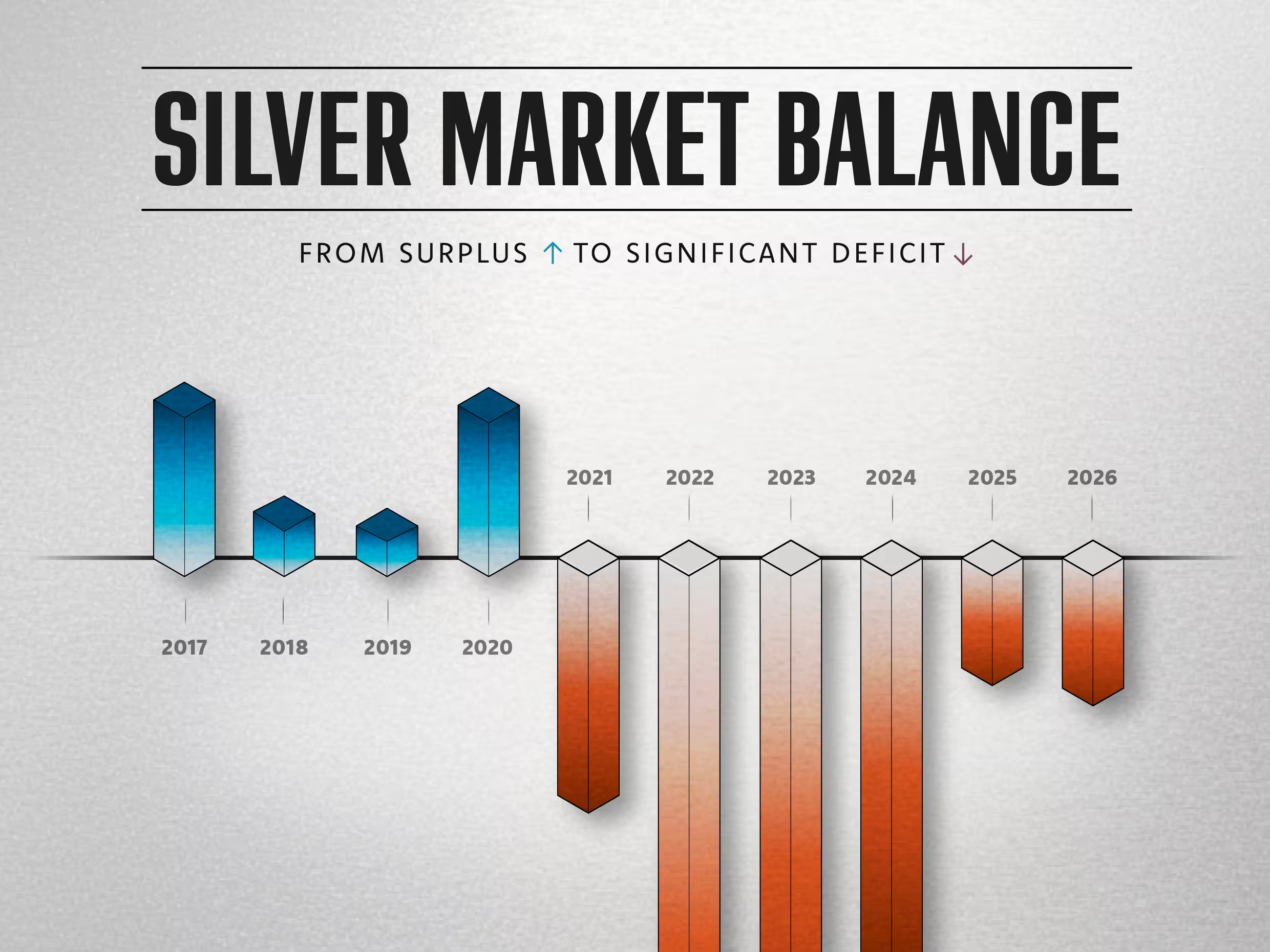
The 2026 price level has developed alongside a different set of market conditions, including a multi-year structural deficit documented by the Silver Institute's World Silver Survey and the 2025 USGS designation discussed above. Whether and how these factors will affect future prices is not knowable from historical data alone.
Conclusion
Silver's 100-year chart is frequently discussed in terms of investor behavior. It can also be read alongside the U.S. government's evolving treatment of the metal: as a monetary asset in the 1930s, as a wartime industrial input in 1942, as a demonetized metal after 1971, and as a critical mineral after 2025. The 2025 designation does not, in itself, determine future price action; it represents a formal change in how U.S. policy categorizes silver and is the most recent annotation on a chart shaped by both market forces and government decisions.